
Bangkok's airports never closed. Thai Airways cut four in ten of its flights anyway.
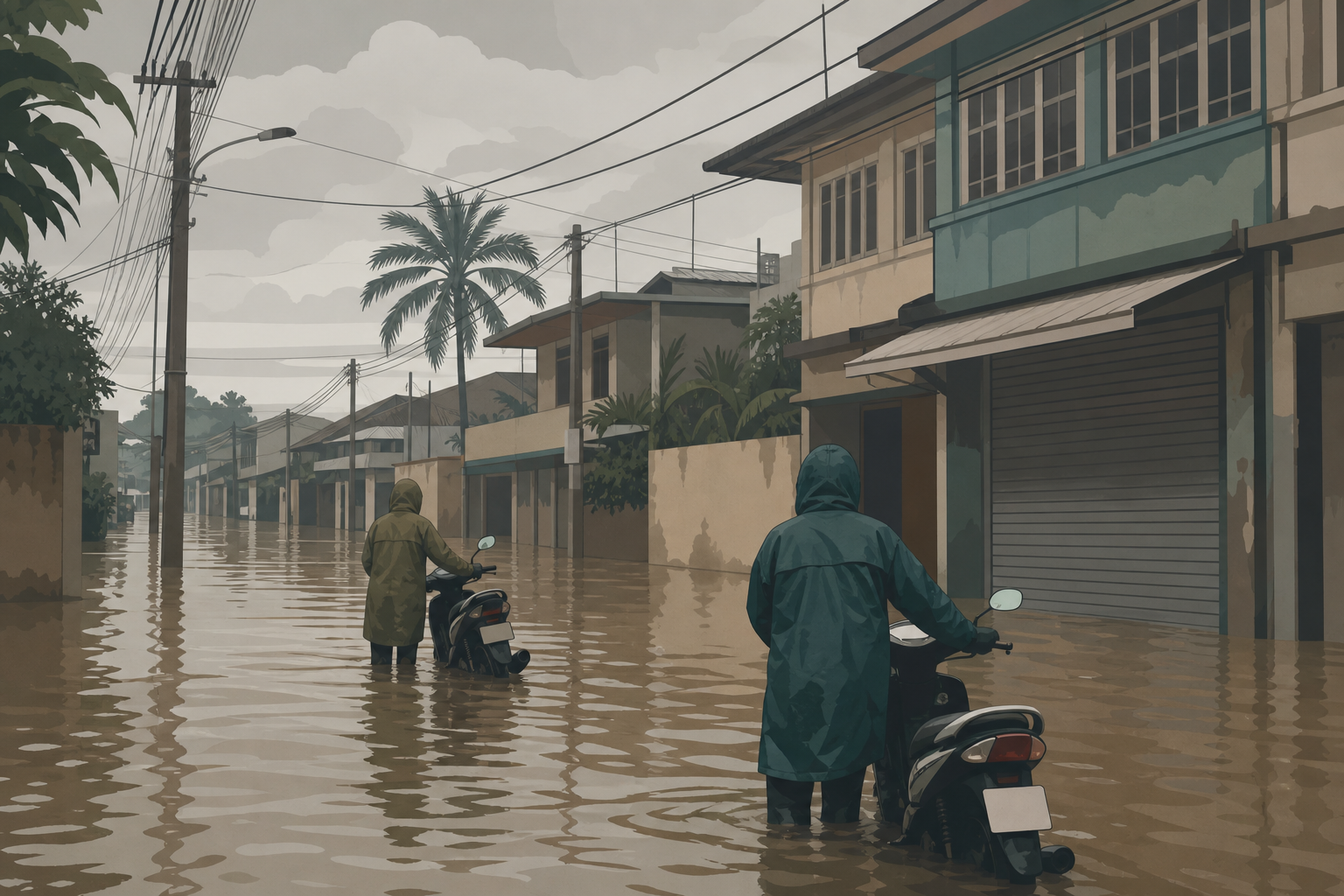
Bangkok took close to a month of rain in about three days. On Saturday 26 September the city's governor, Chadchart Sittipunt, declared all fifty of its districts a disaster zone, and by Monday the Bangkok Metropolitan Administration was counting roughly 329,000 households affected, somewhere near 700,000 people.
Both Bangkok airports stayed open the whole time. That is the part the headlines keep burying. Nothing closed. What broke was Thai Airways, whose ground staff could not physically reach Suvarnabhumi, and the airline has since cancelled flights to Delhi, Mumbai and Bengaluru on three separate days. If you are flying to Thailand this month, the flood is probably not your problem. The airline might be.
Where the water went
Almost 300 mm fell from Thursday afternoon onward, and the Tourism Authority of Thailand put it at more than 300 to 330 mm inside 72 hours. September in Bangkok normally brings about 336 mm across the entire month, on the 1991 to 2020 average. So the city got most of a month in a day and a half.
Forty-two districts flooded at some point. By Sunday 28 September eight were still under water: Lat Krabang, Bang Kapi, Min Buri, Saphan Sung, Suan Luang, Bueng Kum, Khlong Sam Wa and Sai Mai. Notice what is absent. No Sukhumvit, no Silom, no Rattanakosin, no Khao San. The water sat in the eastern and outer districts, where people live rather than where they stay.
The Thai Hotels Association said as much. Its president, Thienprasit Chaiyapatranun, put the affected area at 30 to 40 per cent of the capital, named Srinakarin, On Nut, Bang Kapi and Ramkhamhaeng as the worst of it, and expects city occupancy to fall by under 10 per cent across September and October. Most central hotels escaped direct flooding. This is not 2011.
Lat Krabang matters to you for one reason. It is the district Suvarnabhumi sits in.
The airline, not the airport
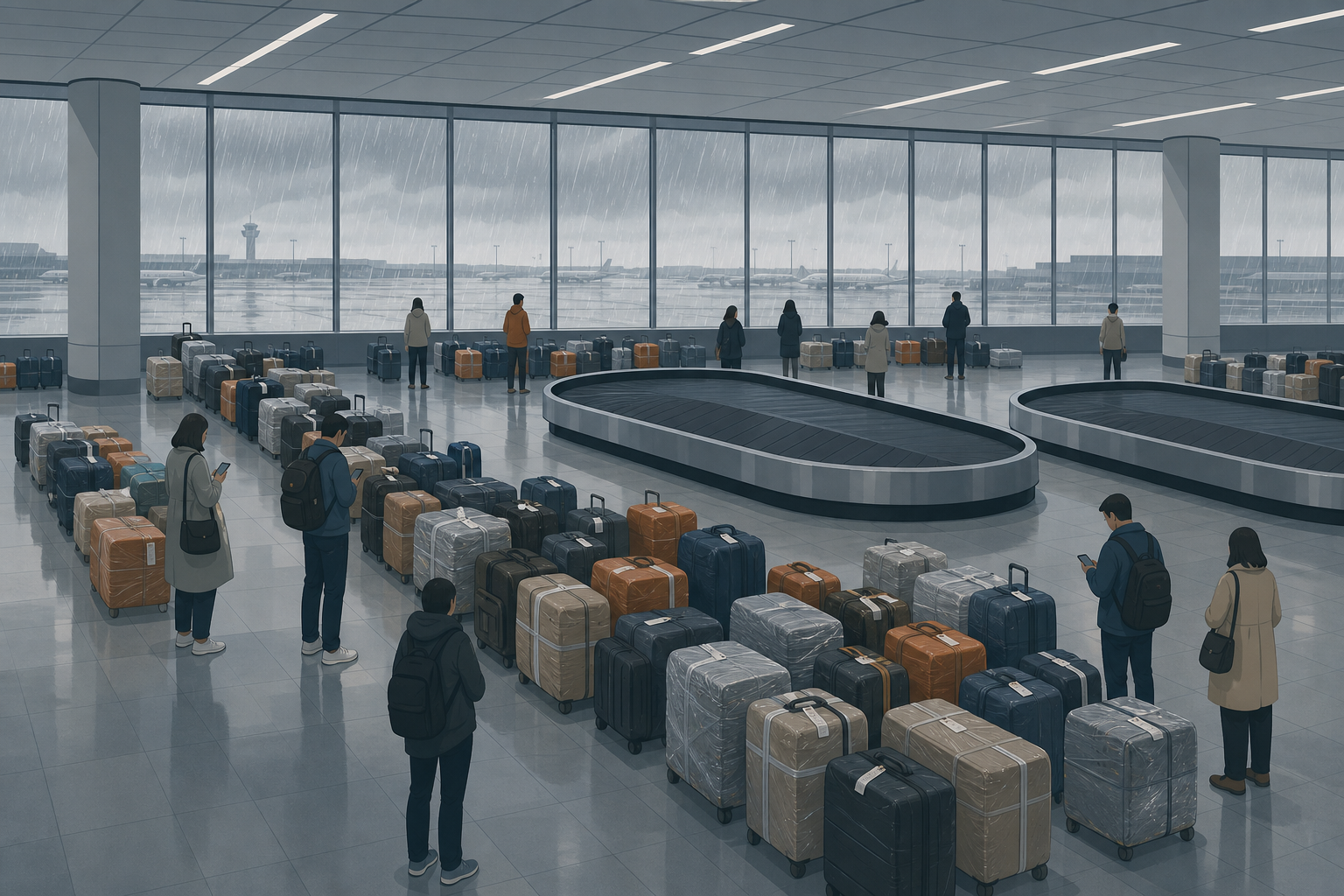
Thai Airways runs about 115 Bangkok departures a day. Over the weekend of 26 to 29 September, TTG Asia reported that fewer than 3 per cent of them left on time. Staff in Lat Krabang and the other flooded suburbs could not get in, so crews could not be rotated, catering went down and the baggage system seized. Over 10,000 bags from flights on 26 to 28 September went unprocessed. Airports of Thailand turned three carousels into sorting floors and the Royal Thai Air Force sent a hundred personnel to help. Passengers waited five or six hours for luggage, some of them overnight, and some flights were declared cancelled after their departure time had already passed.
So the airline cut its own schedule to catch up. Chief executive Chai Eamsiri pulled 28 flights, then another 15 on 1 October, which TTG Asia described as a 30 to 40 per cent cut in Bangkok departures. He wants 105 flights a day by 2 October and a normal schedule within a week of that. He has committed to no date. Counts differ by outlet, from Malay Mail's 59 cancellations since 26 September to Nation Thailand's nearer 75, with over 1,000 transit passengers stuck at Suvarnabhumi on 30 September.
India appeared in the cancellations three days running. Bengaluru and Delhi on 29 September. Delhi and Mumbai on 30 September. Delhi as TG315 and TG316 and Mumbai as TG317 and TG318 on 1 October. No other carrier cancelled an India route, because Bangkok is Thai Airways' home base and everybody else just lands, turns and leaves.
What this costs you
Thai Airways will move you once at no charge if your ticket was issued on or before 26 September for travel between 26 September and 11 October, same route and fare class, finished by 11 October, with a full refund if your flight was the cancelled one. That window was drawn around the crisis, not around your holiday. Six other carriers opened narrower doors, most covering only 26 to 28 September: Thai AirAsia, AirAsia X, Thai Lion Air, Nok Air, Thai Vietjet and Bangkok Airways. Cathay Pacific was the generous one, allowing new dates to 30 November.
Air India and IndiGo have announced nothing. On an Indian carrier to Bangkok this month, normal fare rules apply and a change costs what a change costs. Worth knowing before you ring them expecting sympathy.
What costs real money is a missed connection. A Thai Airways itinerary through Bangkok with a checked bag and an onward leg carries three failure points on an airline that is openly running reduced. Build four hours into it, not ninety minutes, or route through Kuala Lumpur or Singapore this month instead.
If you are going anyway
Go. Phuket and Chiang Mai were never affected, central hotels are dry, and the TAT is calling this a perception problem rather than a demand problem, which is self-serving and also true.
- Take the train to the airport, not a car. The Airport Rail Link, BTS and MRT kept running through the worst of it. Road access to both airports was the weak link, with waterlogging on Lat Krabang Road and Ram Inthra Road.
- Carry three days in your cabin bag: medicines, a change of clothes, chargers, anything with a deadline attached. Eight thousand bags were still awaiting delivery on 30 September, against a clearing rate of about 2,000 a day.
- If a bag goes missing, track it at baggage.airportthai.co.th and call the THAI contact centre on +66 2 356 1111, which runs around the clock. Thai Airways is couriering registered bags to addresses.
- Save the local numbers: TAT 1672, tourist police 1155, emergency 1669, the Thai Meteorological Department 1182.
- Book the refundable rate. Thienprasit's own line was that travellers can now cancel or change two or three days out. Use that instead of paying for certainty nobody can sell you.

One booking to reconsider.
At ₹368 the hop-on river boat is the best value transport in Bangkok in an ordinary week, and the one thing here I would not prepay in early October. The Chao Phraya is where the city has been pumping its floodwater, and piers close when the river runs high. Buy it at the pier on the morning you want it.
For the afternoon that rains on you anyway, two bookings that do not care about weather.
The SEA LIFE and Madame Tussauds combo at ₹352 is the cheapest thing in our Bangkok catalogue, two air-conditioned hours under the Siam Paragon complex, reachable by BTS without setting foot on a street. Do not plan a day around it. Hold it for the afternoon the sky opens. The Oasis Spa on Sukhumvit 31 at ₹3,190 is the better use of a washed-out afternoon for two adults, and Sukhumvit 31 is in the dry part of town.
If your dates are fixed and your appetite for Bangkok has gone, move south rather than cancel.
The Phuket city join tour at ₹1,357 covers the Big Buddha, Chalong temple, Promthep Cape and the old town in a day, and it is the cleanest way to see that Phuket is more than its beaches. Tiger Park with the Big Buddha at ₹1,054 is the cheaper half of the same geography. Book it only if the tigers are the draw, because the enclosures are small.
What is still unclear
The forecast, mainly. The Thai Meteorological Department expects thunderstorms over 40 to 60 per cent of the country through the first half of October, with 80 to 120 mm of rain across 9 to 12 wet days. That is an ordinary Thai October, not a second disaster, but the city needs dry days to finish draining and is not being offered many.
Thai Airways has published an intention, not a date. On 30 September the Transport Minister and Deputy Prime Minister, Phiphat Ratchakitprakarn, was publicly instructing the airline to keep cargo moving rather than suspend it, which tells you how little slack the operation had. U-Tapao was standing by as an alternate airport through 4 October. By that same day the city found standing water at 12 of the 240 locations it monitors, mostly 5 to 20 cm deep.
Book Thailand anyway. Book a seat you can move, pack a bag you can carry, and give Suvarnabhumi more time than you think it needs.
The airports never shut. One airline ran out of people who could get to work. Those are different emergencies and only one of them is yours.
Figures and dates come from Al Jazeera, Nation Thailand, Khaosod English, TTG Asia, Malay Mail, the Tourism Authority of Thailand's advisory of 27 September and its Golden Week statement of 28 September, the Thai Hotels Association, the Thai Meteorological Department and Wego's compilation of airline waivers, all read on 1 October 2026. Waiver windows and cancellation lists were moving daily while this was written, so check your own airline before acting on it.