
Book Vietnam for Diwali. Just not the middle of it.
The Indian holiday calendar and the Vietnamese weather calendar disagree this year, and almost nobody books around it. Puja holidays fall around 17 to 21 October. Diwali is 8 November. Those are the two weeks most Indian families can get away, and both sit inside the worst stretch of the year for the middle of Vietnam.
Last year gives you the scale. Flooding across the central provinces started on 16 October and did not finish until 6 December. Bach Ma station recorded 1,739.6 mm of rain in twenty-four hours over 26 and 27 October, a national record. At least 219 people were killed or went missing. Hoi An's old town spent November being pumped out.
This is not an argument against Vietnam. The country is about 1,650 km end to end and its three regions run on completely different weather. While Hoi An is under water, Hanoi is dry, in the low twenties, and having its best month of the year. The trip is fine. The map needs turning.
The north is at its peak in exactly these weeks
Late September to November is the north's window: clear skies, 20-something degrees, no humidity worth complaining about. If you have flown to Vietnam for Diwali and you land in Hanoi, you have accidentally got the timing right.
Hanoi rewards two or three days. The Old Quarter is best walked, but the things worth seeing sit across several districts and the traffic will eat an afternoon if you link them yourself. A full-day guided run covers the spread on day one, so you know which neighbourhood to return to on foot.
One timing note that costs nothing: pho is breakfast food here. Good stalls sell out before midday. A pho plan for 1pm is a plan to eat what nobody else wanted.
Ha Long Bay, and the version of it most people book
The arithmetic on the day trip rarely makes it into the brochure. Hanoi to Ha Long is about 155 km, roughly two and a half hours each way. Pickup is 7 or 8am and you are back at your hotel by 8 or 9pm. That is twelve to thirteen hours door to door to buy four to six hours on the bay, and only about three of those are spent moving through the karsts. The rest is a cave, a kayak, an island stop and lunch. You also miss sunrise and sunset, which is when the bay looks like the photograph that made you want to come.
If Ha Long is the reason you picked Vietnam, sleep on the water. If it is one item on a longer list, the day trip is fine, provided you book it knowing you are buying a bus journey with a boat in the middle. Three options, in ascending order of how much you care.
Ninh Binh does the same job in half the driving
Same limestone, same green water, about 100 km from Hanoi instead of 155, roughly two hours by car. You get a rowboat through flooded karst valleys at Trang An or Tam Coc and you are back in the city for dinner rather than staggering in at nine.
The climb at Mua Cave is close to 500 stone steps and takes most people 45 minutes to an hour. Entry is a hundred thousand dong, around ₹370: the best view in northern Vietnam for under four hundred rupees. It is also a real climb, so if knees are a question in your group, the boat is enough of a day on its own.
Travelling with parents and only one day free outside Hanoi? Take this over Ha Long. Less road, more landscape.
Sapa, with one warning that cuts against it
The mountains are four or five hours northwest of Hanoi and October and November weather up there is excellent: cool, clear, very long views. But the rice terraces you have seen photographs of turn golden from about mid-August to mid-September. By late October the fields are cut. By November they are bare earth and stubble. Go for the ridgelines, the villages and the walking, all of which are still there, and do not go expecting the yellow terraces, because you will have missed them by six weeks.
The overnight train also does not reach Sapa. It stops at Lao Cai, an hour short, and you finish on a mountain road at six in the morning having barely slept. A daytime limousine van takes five and a half to six hours and is the better trip by a wide margin. Take the trekking itinerary to walk between villages, the standard tour to see the place from a comfortable seat.
The middle of the country, if you insist
Plenty of people have already booked Da Nang and Hoi An, and some of those trips will be fine. Typhoon season is a probability, not a certainty. But go in with your eyes open. September to November is the highest-risk window for storms and cancelled flights in central Vietnam, and October and November are when Hoi An's old town floods, sometimes knee to waist deep.
Two things follow. Buy the flexible fare. And do not put central Vietnam at the end of your trip, where a washed-out day cannot be rescheduled and a cancelled flight makes you miss your ride home.
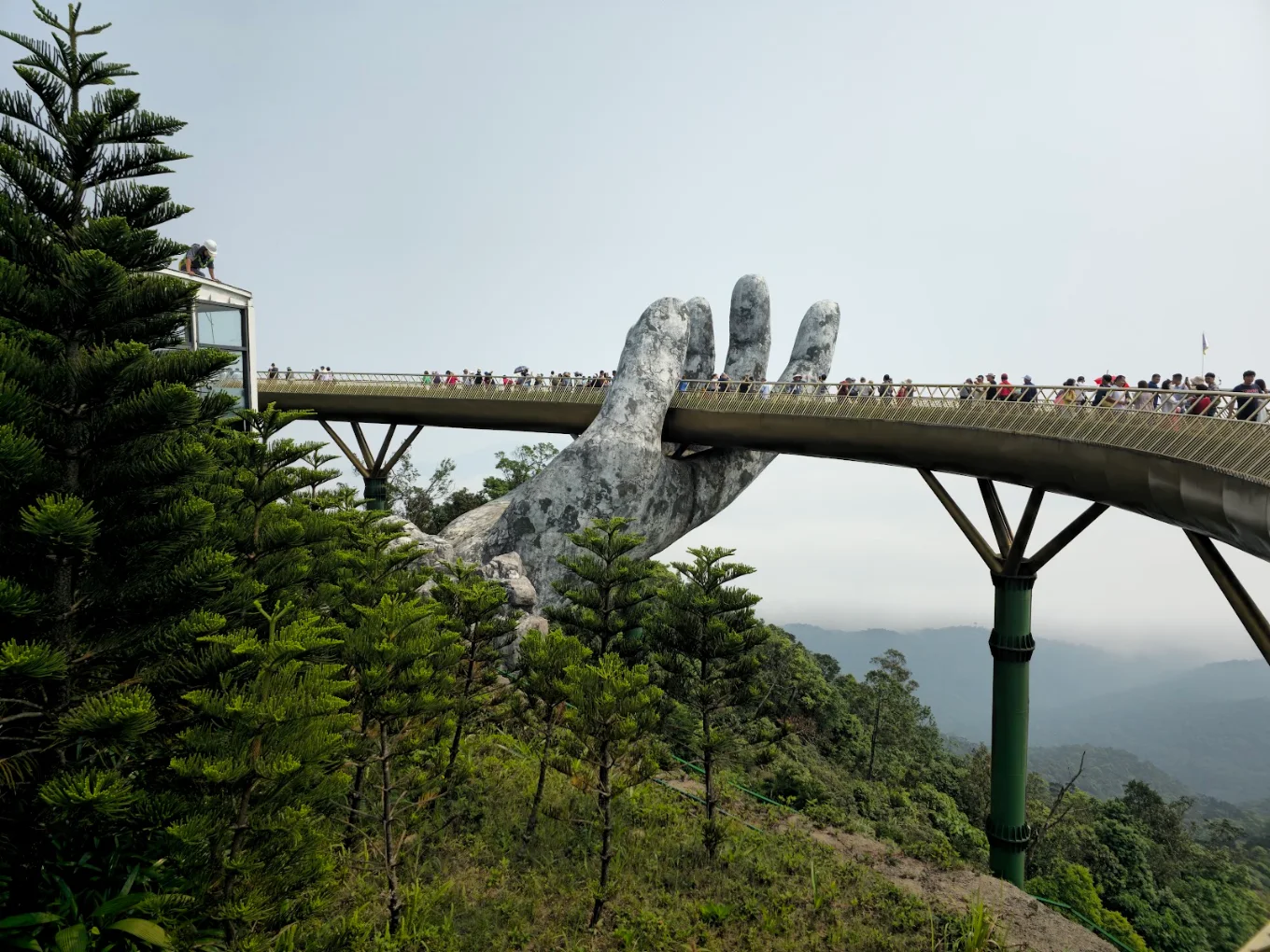
Ba Na Hills and the Golden Bridge is what everyone goes for, so be clear about what it is: a walkway inside a French-village theme park on a mountain, not a remote landmark. Adult entry is nine hundred and fifty thousand dong, about ₹3,500, which is serious money by Vietnamese standards. Clear skies in Da Nang tell you nothing about the summit, cloud swallows that bridge regularly, and there is no refund for fog. Be on the first cable car between 7.30 and 8.30am; by ten it is packed.
Or go south, where November is the start of the good months
The south runs on the opposite calendar. Dry season in Ho Chi Minh City, the Mekong and the islands begins around November and holds until April. A Diwali trip on 8 November arrives just as the south improves, which is the most useful answer to the timing problem and the one fewest people take.
Saigon is the city Hanoi is not: louder, newer, considerably more interested in money. The Cu Chi tunnels are the standard half-day out and they earn it, though the tunnel sections are narrow, hot and no place for anyone claustrophobic. The Mekong day trip is gentler, with one caveat: most versions include a coconut-candy stop and a honey farm where somebody will try to sell you things. Treat that twenty minutes as the price of the boat.
If you only pick one of the three, pick the street food tour. Saigon is where banh mi was invented and it is the best eating city in the country.
Phu Quoc, and a visa trap worth reading twice
Phu Quoc is the beach answer, and from November the sea behaves. It also comes with a rule that sounds generous and has teeth. Foreigners can enter Phu Quoc visa-free for thirty days if they arrive directly from outside Vietnam and the island is their only Vietnamese destination. The catch is that India currently has no direct flights to Phu Quoc, so you will connect through Hanoi or Ho Chi Minh City. Staying airside in transit is allowed. The moment you clear immigration on the mainland, the exemption is gone.
The Consulate General of India in Ho Chi Minh City published an advisory on 9 May 2026 recommending that Indians travelling to Phu Quoc get a proper Vietnam visa anyway, because a medical emergency or a cancelled flight can put you on the mainland without permission to be there. The same advisory notes that if you lose your passport, Vietnamese authorities take three to five working days to issue an exit permit. Twenty-five dollars is cheap insurance against that week.
On the island, the Hon Thom cable car is the longest over-sea cable car in the world and the ride is the attraction, not what waits at the far end. The three-island speedboat trip is the better half-day if you would rather be in the water than above it.
Eating as a vegetarian, without the guesswork
Most Vietnam guides skip this, and it is what goes wrong most often for Indian travellers. Fish sauce, nuoc mam, is in almost everything, including dishes described as vegetable. Standard pho broth is simmered on beef or chicken bones, so vegetable pho at an ordinary stall is usually meat stock with vegetables sitting in it. Shrimp paste turns up in dipping sauces without announcing itself. Asking for no meat solves none of this.
One Vietnamese word solves it. Chay, pronounced roughly like "chai", means vegetarian in the Buddhist sense. Look for signs reading quán chay or cơm chay. These are proper restaurants with centuries behind them, usually clustered near pagodas, and not a tourist accommodation. Pho chay, banh mi chay and goi cuon chay are all excellent. Learn one sentence: Tôi ăn chay, không nước mắm. I eat vegetarian, no fish sauce. Say both halves, because either alone gets misread.
Two more things. On the first and fifteenth day of each lunar month many Vietnamese eat meat-free and ordinary restaurants widen their vegetarian menus a long way, so plan a temple-district meal around it. And if someone in your group is strictly Jain, plan on Indian restaurants and chay kitchens that cook to order. Vietnam has no Jain tradition to lean on, though Hanoi, Saigon, Da Nang, Hoi An and Phu Quoc all have Indian restaurants, several of them pure vegetarian.
A market-and-cooking-class morning is the cheapest way to fix this for the rest of the trip. You learn which herbs you are looking at, and what to ask for.
The practical half hour before you book
- The visa is a government website, not an agent. Vietnam's e-visa runs at evisa.gov.vn and thithucdientu.gov.vn, and nothing else is official. It is valid up to 90 days, single or multiple entry, at around USD 25 single or USD 50 multiple. Agency sites resubmit your form to that same portal and charge three to six times more. Apply two weeks out, not two days: processing runs three to five working days and stretches in peak season.
- Flights land in Hanoi. Delhi to Hanoi is about four and a half hours, Kolkata a little over three. Vietnam Airlines, VietJet, IndiGo and Air India all fly it, Akasa added Mumbai to Hanoi this month, and IndiGo starts the same route in late October. There are no nonstops from India to Da Nang or Phu Quoc, so those trips involve a connection whatever the package implies.
- Domestic flights are absurdly cheap. Hanoi to Da Nang is 1 hour 25 minutes, Hanoi to Saigon 2 hours 10 minutes, the latter around 47 times a day. Skip the 32-hour train unless the train is the point. VietJet and Vietravel price bags separately, so the cheap fare is not the fare.
- Money: drop three zeros and multiply by 3.7. A hundred thousand dong is about ₹370. Pho runs ₹145 to ₹290, a Grab across Hanoi ₹300 to ₹550. Cards work at hotels and malls; the street is cash. Withdraw the maximum per transaction, because the ATM's fee is a flat ₹80 to ₹245 before your Indian bank adds anything.
- Learn two banknotes before you land. Five hundred thousand dong and twenty thousand dong are both blue. Swapping one for the other while making change is the most common way visitors here lose real money.
- Do not rent a scooter. Vietnam recognises international driving permits issued under the 1968 Vienna Convention. India issues the 1949 Geneva version. Rental shops will hand you a bike for a passport and no questions, which is not the same as it being legal, and your insurance almost certainly excludes a motorbike accident you had no licence to be in. GrabBike costs ₹55 to ₹110 a hop.
- Book the ride in from the airport. An arrivals hall at the end of a five-hour flight is where tired people make expensive decisions.
The north is dry in October and November. The south dries out from November. The middle is the part that floods. Almost every Vietnam itinerary being sold for Diwali week treats those three as interchangeable.
Nothing here asks you to give anything up. Vietnam is long enough that a bad month in one place is a good month in another, and the Diwali window lands on the north at its very best. Going is not the mistake. Booking the middle third of a country during the eight weeks it spends underwater, and hoping, is.